Most safety toolbox talks fail before they start. Workers zone out. Supervisors read from generic PDFs. The same topics rotate endlessly: "Hard hats save lives," "Watch for forklifts." The result? Complacency. Missed near-misses. Preventable incidents.
The truth: effective daily safety toolbox topics aren’t about checking a box. They’re about changing behavior. They’re timely, relevant, and rooted in real risks your team faces today—not risks from a decade-old safety manual.
This guide cuts through the noise. You’ll learn how to select, structure, and deliver toolbox topics that stick, with real-world examples, common pitfalls, and actionable formats.
Why Most Toolbox Talks Fall Flat
Toolbox talks are meant to be quick safety huddles—5 to 15 minutes—focused on one specific hazard or safe practice. But too many devolve into monologue-style lectures on broad themes like "General Safety Awareness" or "Personal Protective Equipment."
These topics fail because they: - Lack immediacy (not tied to current work or conditions) - Are too vague ("Be safe today") - Ignore worker input - Repeat the same content monthly
For example, talking about fall protection on a ground-level electrical installation day makes little sense—even if falls are a priority. Relevance drives engagement.
Workers tune out when they feel talked at, not with. A real conversation about a hazard spotted during the morning walk-through? That gets attention.
How to Choose High-Impact Daily Safety Topics
The best topics respond to real conditions. Use a simple framework: Observe, Identify, Discuss.
Observe Walk the site daily. Note:
- New equipment or trades arriving
- Weather changes (heat, rain, wind)
- High-risk activities (lifting, confined spaces, hot work)
- Behavioral cues (rushed movements, PPE not worn properly)
Identify Ask: "What could go wrong today?" Prioritize:
- High-consequence risks (falls, electrocution, struck-by)
- Recurring near-misses
- Seasonal hazards (heat stress in summer, icy walkways in winter)
- New or inexperienced workers on site
Discuss Frame the topic as a question or scenario:
- "What would you do if the fire alarm went off during crane operation?"
- "Have you seen this ladder setup before? What’s wrong with it?"
This method turns passive listeners into active participants.
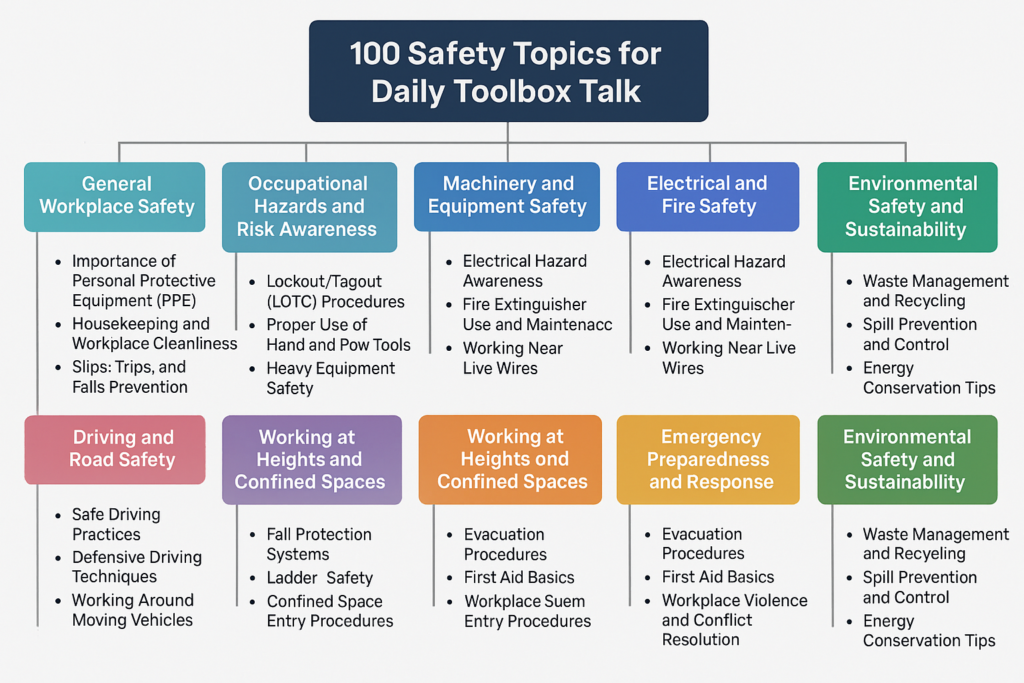
10 Proven Daily Safety Toolbox Topics (With Examples)
Use these as templates. Customize based on your site conditions.
1. Ladder Safety: The 3-Point Contact Rule
Many falls happen on ladders under 6 feet. Focus on proper setup and body positioning. Example: Show a photo of a worker leaning too far to the side. Ask: "What’s wrong here?" Teach the 3-point contact rule—two hands and one foot, or two feet and one hand—always on the ladder.
2. Housekeeping: How Clutter Kills Productivity and Safety Trips, slips, and fire hazards stem from poor housekeeping. Example: Point to a congested aisle with loose cables and materials. Challenge the team: "How would we evacuate here in an emergency?" Assign cleanup zones and rotate responsibility.
3. Hot Work Permits: Why One Spark Can Change Everything Even small welding jobs can ignite hidden debris. Example: Share an incident where a spark traveled through a wall cavity and ignited insulation. Review permit steps: fire watch, clearance, extinguisher on-site.
4. Lockout/Tagout (LOTO): Is That Machine Really Off? Assumption kills. Workers often bypass formal LOTO during "quick fixes." Example: Walk through a mock maintenance task. Have someone pretend to open a panel. Ask: "What energy sources are isolated? Can we verify zero energy?"
5. Fall Protection: Anchors, Harnesses, and Edge Awareness Falls remain the leading cause of construction fatalities. Example: Inspect harnesses as a group. Check D-rings, webbing, and expiration dates. Demonstrate proper anchor points—never on scaffolding guardrails.
6. Hand Tool Hazards: The Hidden Risks of Common Tools Wrenches, hammers, and grinders cause cuts, impacts, and flying debris. Example: Show a cracked grinding wheel. Ask: "Would you use this?" Review inspection criteria and eye protection requirements.
7. Slips, Trips, and Falls: It’s Not Just About Height 60% of slip-and-fall incidents happen on same-level surfaces. Example: Map "hot spots" on site—muddy transitions, wet concrete areas. Assign absorbent mats and signage.
8. **PPE Compliance: Beyond Wearing
It—Wearing It Right* Wearing a hard hat backwards or safety glasses on your forehead defeats the purpose. Example:* Conduct a gear check. Praise correct use. Address shortcuts without shaming.
9. Emergency Response: Do You Know Your Role? In a crisis, hesitation costs lives. Example: Run a 2-minute drill: "Fire in the electrical room—what do you do?" Confirm evacuation routes and assembly points.
10. Fatigue and Mental Focus: When Tired Minds Cause Accidents Long shifts, early starts, and stress impair judgment. Example: Share a real-world incident where fatigue led to a misread gauge. Encourage workers to speak up if they’re not fit for duty.
Avoid These Common Toolbox Talk Mistakes
Even well-intentioned talks can backfire. Watch for these traps:
1. Reading from a Script Workers detect disengagement instantly. Use bullet points, not paragraphs. Speak naturally.
2. Ignoring Site Conditions Talking about trench safety on a day with no excavation work feels irrelevant. Adapt on the fly.
3. No Follow-Up Did the team promise to clean up extension cords? Check the next day. Accountability matters.

4. One Person Dominates Ensure quieter workers get space to speak. Ask direct, open-ended questions: "Jamal, what would you do in that scenario?"
5. Skipping Documentation Even brief talks should be logged: topic, attendees, date. It’s not bureaucracy—it’s proof of due diligence.
Make It Interactive: Techniques That Drive Engagement
Passive listening = forgotten content. Interaction = retention.
Try these methods:
Scenario-Based Questions "Imagine you’re about to enter a confined space and the gas monitor alarms. What are your next three steps?"
Show and Tell Bring in a damaged harness or faulty tool. Let workers identify the hazard.
Role Play Act out an emergency evacuation. Time it. Debrief what worked and what didn’t.
Hazard Bingo Create cards with common risks (exposed wiring, missing guardrails). Workers mark them during the day. Reward spot-check wins.
Group Problem-Solving Present a real near-miss. Ask: "How could this have been prevented? What would you change?"
Interaction doesn’t require props or tech. It just requires intention.
Integrating Toolbox Talks Into Daily Workflow
The best talks happen before work starts—not as an afterthought.
Timing Matters Schedule talks:
- At shift start
- Before high-risk tasks
- After breaks when focus drops
Avoid end-of-day fatigue. A 3 PM talk about crane safety during a 6 AM lift won’t land.
Location, Location, Location Hold talks where the work happens. Discuss ladder safety at the ladder. Talk excavation hazards at the trench.
On-site context reinforces relevance.
Rotate Facilitators Have crew leads or experienced workers run occasional talks. It builds ownership and surfaces ground-level insights.
One superintendent found that when apprentices led talks, engagement jumped 40%. They asked questions their peers actually cared about.
Measuring Impact: Beyond Attendance Sheets You can’t improve what you don’t measure.
Track: - Near-miss reports (are they increasing? That’s good—means people are speaking up) - Behavioral observations (PPE compliance, safe tool handling) - Incident trends (are repeat issues declining?) - Worker feedback (anonymous drop box or quick poll)
One contractor reduced hand injuries by 70% in six months by focusing weekly talks on pinch-point risks and verifying glove use daily.
That’s not luck. That’s targeted, data-informed safety.
Closing: Turn Safety Talks Into Safety Actions
Daily safety toolbox topics work when they’re specific, timely, and participative. Ditch the recycled PowerPoints. Talk about what’s actually happening on site. Ask questions. Listen. Follow up.
A great toolbox talk doesn’t end when the huddle breaks. It ends when someone spots a hazard, speaks up, and prevents an incident.
Start tomorrow: pick one real risk, gather your team, and ask, "How do we stay safe with this today?" That’s how culture changes—one conversation at a time.
Frequently Asked Questions
What should a daily safety toolbox talk include? A focused hazard, real-world example, discussion questions, and a clear safety action. Keep it under 15 minutes.
How often should toolbox talks happen? At least weekly, but daily is ideal—especially on high-risk sites or during critical tasks.
Who should lead a toolbox talk? Supervisors typically lead, but rotating crew leads or experienced workers increases engagement.
Can toolbox talks reduce workplace incidents? Yes—when they’re relevant and behavior-focused. Sites using targeted talks see fewer near-misses and lower injury rates.
Should toolbox talks be documented? Yes. Record topic, date, attendees, and key points. It supports compliance and tracks progress.
How do I keep toolbox talks from feeling repetitive? Tie topics to current work, rotate formats (scenario, demo, Q&A), and solicit worker input.
What’s the biggest mistake in safety toolbox talks? Talking about safety instead of engaging workers in doing safety. Interaction beats lecture every time.
FAQ
What should you look for in Daily Safety Toolbox Topics for Smarter Worksite Risk Control? Focus on relevance, practical value, and how well the solution matches real user intent.
Is Daily Safety Toolbox Topics for Smarter Worksite Risk Control suitable for beginners? That depends on the workflow, but a clear step-by-step approach usually makes it easier to start.
How do you compare options around Daily Safety Toolbox Topics for Smarter Worksite Risk Control? Compare features, trust signals, limitations, pricing, and ease of implementation.
What mistakes should you avoid? Avoid generic choices, weak validation, and decisions based only on marketing claims.
What is the next best step? Shortlist the most relevant options, validate them quickly, and refine from real-world results.